






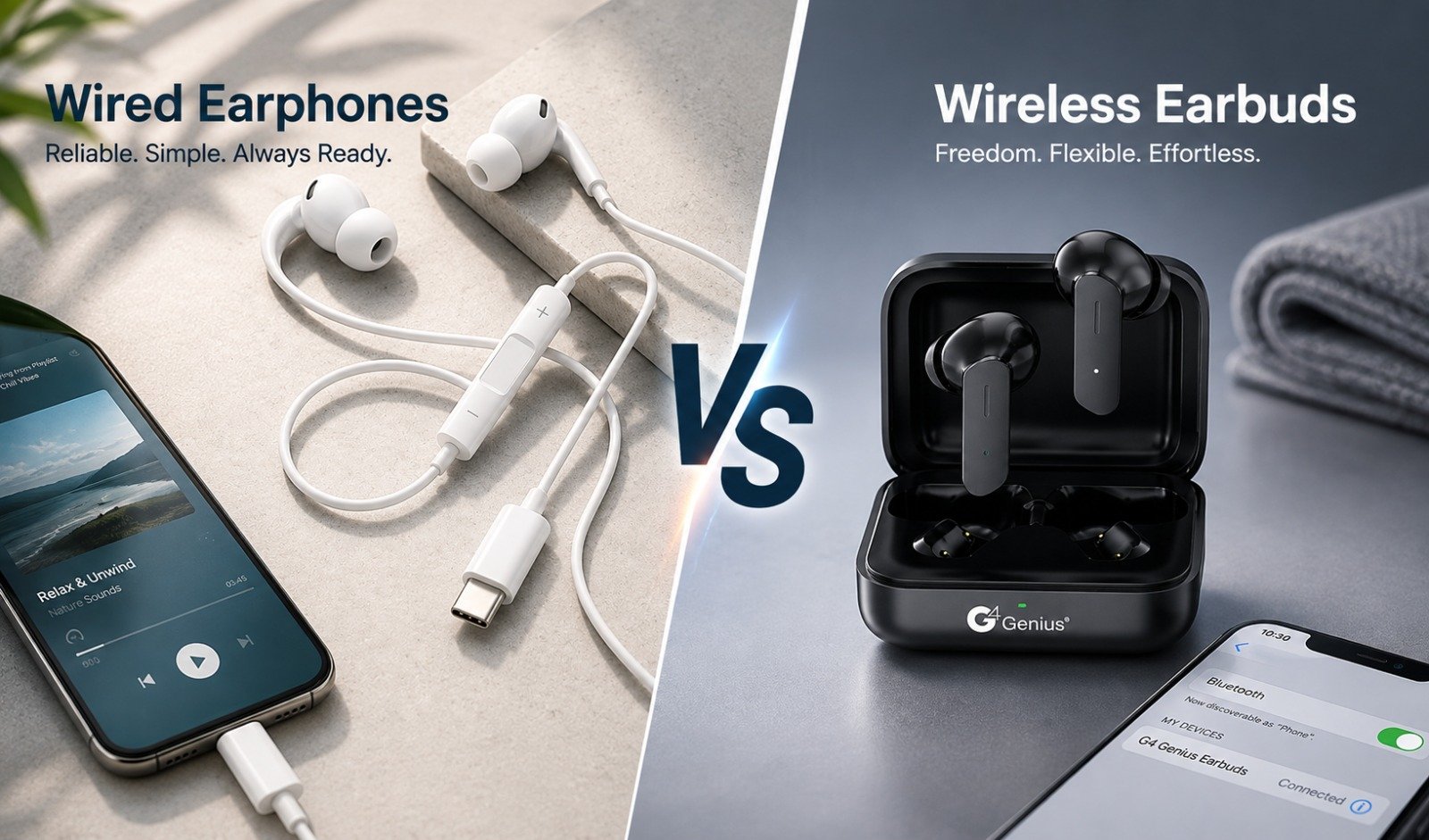
Wired Earphones vs Wireless Earbuds – Choosing between wired earphones and wireless earbuds can be confusing. Both options are designed for listening to music, taking calls, watching videos, gaming, and everyday entertainment, but they provide very different user experiences.
Wired earphones offer a simple plug-and-play connection without requiring a separate battery in the earphones. Wireless earbuds, on the other hand, provide cable-free convenience, portability, and features such as touch controls, Bluetooth connectivity, and charging cases.
So, which one should you buy?
The answer depends on how you use your audio device. Sound quality, convenience, battery life, latency, comfort, price, durability, calling requirements, and device compatibility can all influence your decision.
In this complete comparison, we will examine wired earphones vs wireless earbuds to help you decide which option is better for your needs.
What Are Wired Earphones?
Wired earphones connect directly to a smartphone, laptop, tablet, or other compatible device using a physical cable.
Depending on the device, wired earphones may use connectors such as:
- 3.5mm audio jack
- USB Type-C
- Lightning
Traditional 3.5mm earphones remain common, while USB Type-C wired earphones have become increasingly relevant as many modern smartphones no longer include a dedicated headphone jack.
One of the biggest advantages of wired earphones is simplicity. Connect them to a compatible device and they are generally ready to use without Bluetooth pairing or charging the earphones separately.
What Are Wireless Earbuds?
Wireless earbuds are compact audio devices that connect to smartphones and other compatible devices primarily through Bluetooth.
True wireless earbuds do not require a cable between the phone and earbuds or between the left and right earbuds.
Most wireless earbuds include a charging case that stores and recharges the earbuds when they are not being used.
Modern wireless earbuds may offer features such as:
- Bluetooth connectivity
- Touch controls
- Built-in microphones
- Environmental Noise Cancellation (ENC) for calls
- Active Noise Cancellation (ANC) on supported models
- Low-latency gaming modes
- Voice assistant support
- Water or sweat resistance
- Charging cases
- Fast charging
- Multi-device features on selected models
Wireless earbuds are particularly popular among users who prioritize portability and freedom from cables.
Wired Earphones vs Wireless Earbuds: Quick Comparison
| Feature | Wired Earphones | Wireless Earbuds |
|---|---|---|
| Connection | Physical cable | Bluetooth |
| Battery Required | Usually No | Yes |
| Charging Case | No | Usually Yes |
| Portability | Good | Excellent |
| Cable Tangles | Possible | No connecting cable |
| Latency | Generally very low | Varies by model/codec |
| Setup | Plug and play | Pairing required |
| Calling | Model dependent | Model dependent |
| Gaming | Very good for low latency | Good with suitable low-latency models |
| Price | Often more affordable | Wide price range |
| Controls | Inline on many models | Touch/button controls |
| Device Compatibility | Depends on connector | Depends on Bluetooth support |
| Risk of Losing | Lower | Individual buds can be easier to misplace |
Both categories have clear advantages, so the better option depends on your priorities.
1. Sound Quality
Sound quality is one of the most important factors when choosing any audio product.
Wired Earphones
Wired earphones transmit the audio signal through a physical connection. They do not rely on Bluetooth transmission.
This can provide consistent audio performance without Bluetooth codec limitations or wireless interference.
However, being wired does not automatically mean an earphone will sound better. Driver quality, tuning, fit, materials, and overall acoustic design are also important.
Wireless Earbuds
Modern Bluetooth earbuds can provide excellent sound quality.
Their performance depends on factors such as:
- Driver quality
- Audio tuning
- Bluetooth codec
- Bluetooth implementation
- Ear tip fit
- Device compatibility
High-quality wireless earbuds can deliver powerful bass, clear vocals, and detailed audio suitable for everyday listening.
Winner for Sound Quality
It depends on the product.
Wired earphones can offer excellent performance at relatively affordable prices, while premium wireless earbuds can also deliver impressive audio.
2. Convenience
This is where wireless earbuds have a major advantage.
Wired Earphones
Wired earphones are easy to use, but the cable can sometimes become tangled or get caught on clothing and objects.
Wireless Earbuds
Wireless earbuds remove the physical cable between your phone and ears.
You can keep your phone in your pocket or bag while:
- Walking
- Exercising
- Travelling
- Working
- Taking calls
- Listening to music
Winner for Convenience
Wireless Earbuds
For users who value freedom of movement, wireless earbuds are generally more convenient.
3. Battery Life
Battery requirements create one of the biggest differences between the two categories.
Wired Earphones
Traditional wired earphones do not have a separate battery that needs regular charging.
Connect them to a compatible device and use them as long as the source device can power them.
Wireless Earbuds
Wireless earbuds require batteries.
Battery life varies significantly between models. The charging case usually extends total listening time by allowing the earbuds to recharge when stored.
Eventually, both the earbuds and charging case need to be recharged.
Winner for Battery Convenience
Wired Earphones
If you do not want another device to charge, wired earphones are simpler.
4. Gaming and Latency
Latency refers to the delay between an action happening on the device and the sound reaching your ears.
This can be particularly noticeable in games.
Wired Earphones
Wired connections generally provide very low latency, making wired earphones a strong option for gaming.
They can be particularly useful for:
- Competitive gaming
- Shooting games
- Rhythm games
- Real-time audio monitoring
Wireless Earbuds
Bluetooth introduces some amount of latency, although modern earbuds may include low-latency or gaming modes designed to reduce the delay.
The actual experience varies according to the earbuds, smartphone, Bluetooth implementation, and codec.
Winner for Gaming
Wired Earphones for consistently low latency.
Wireless earbuds can still be a good choice for casual gaming, especially models specifically designed with low-latency modes.
5. Calling Experience
Both wired and wireless options can provide good call quality.
Wired Earphones
Many wired earphones include an inline microphone positioned on the cable.
A well-designed microphone can provide clear voice pickup for everyday calls.
Wireless Earbuds
Wireless earbuds generally have microphones built directly into the earbuds.
Some models include multiple microphones and technologies such as ENC designed to improve voice pickup during calls.
Call quality can vary significantly between products, especially in noisy environments.
Winner for Calls
Depends on the model.
If calling is a priority, compare microphone quality rather than choosing solely based on wired or wireless connectivity.
6. Comfort
Comfort depends heavily on design and personal preference.
Wired Earphones
Wired earphones are often lightweight because they do not need to contain large batteries.
However, the cable can sometimes pull against the ears during movement.
Wireless Earbuds
Wireless earbuds provide cable-free comfort but contain batteries and electronic components.
Fit is especially important because true wireless earbuds need to stay securely in the ears without support from a connecting cable.
Different ear-tip sizes can help improve fit on compatible models.
Winner for Comfort
Personal preference.
For active movement, many users prefer wireless earbuds. For long stationary listening sessions, lightweight wired earphones can also be very comfortable.
7. Portability
Both options are portable, but they work differently.
Wired Earphones
Wired earphones can be folded and stored in a pocket, pouch, or bag.
However, cables may become tangled if they are not stored properly.
Wireless Earbuds
Wireless earbuds are extremely compact and usually come with a protective charging case.
The case makes them easy to carry, although individual earbuds can be easier to misplace.
Winner for Portability
Wireless Earbuds
Their compact cable-free design makes them particularly convenient for everyday carrying.
8. Durability
Durability depends on build quality and how the product is used.
Wired Earphones
Common wear points include:
- Cable
- Connector
- Inline remote
- Cable joints
- Earphone housing
Frequent bending near the connector or earpieces can eventually damage poorly constructed cables.
Wireless Earbuds
Wireless earbuds eliminate cable damage but introduce other components, including:
- Batteries
- Charging contacts
- Charging case
- Hinges
- Electronic components
Battery capacity also naturally declines over long-term use.
Winner for Durability
Depends on construction and usage.
A well-built wired earphone or wireless earbud can both provide reliable everyday performance.
9. Price and Value for Money
Price is another important consideration.
Wired Earphones
Wired earphones are available across many price points, including highly affordable options.
Because they do not require batteries, charging cases, and wireless electronics, manufacturers can often deliver good audio performance at lower prices.
Wireless Earbuds
Wireless earbuds contain more technology and components.
Depending on the model, you may be paying for features such as:
- Bluetooth
- Charging case
- Multiple microphones
- Touch controls
- ENC
- ANC
- Gaming mode
- Fast charging
- Water resistance
Winner for Budget Buyers
Wired Earphones
If your priority is simple audio and calls at an affordable price, wired earphones can offer strong value.
10. Workout and Gym Use
Movement can influence which option is more convenient.
Wired Earphones
The cable may move around, rub against clothing, or get caught during exercise.
Wireless Earbuds
Wireless earbuds eliminate the connecting cable, making them convenient for:
- Running
- Gym workouts
- Walking
- Cycling in appropriate safe environments
- General fitness activities
For workouts, also check whether the earbuds have an appropriate water/sweat resistance rating.
Winner for Workouts
Wireless Earbuds
Cable-free movement is usually more convenient for exercise.
11. Travel
Both types can work well for travel.
Wired earphones are useful because they do not require separate charging.
Wireless earbuds are convenient because they are compact and easy to use while walking through airports, stations, or other travel environments.
If your journey is long, total battery life becomes an important consideration when using wireless earbuds.
Winner for Travel
Wireless earbuds for convenience; wired earphones for battery-free simplicity.
12. Device Compatibility
Compatibility should always be checked before purchasing.
Wired Earphones
The connector must match your device.
Common options include:
- 3.5mm
- USB Type-C
- Lightning
Some USB-C devices may have specific digital-audio compatibility requirements, so not every USB-C earphone necessarily works with every USB-C device.
Wireless Earbuds
Most modern smartphones, tablets, and laptops support Bluetooth.
This gives wireless earbuds broad compatibility across many device categories.
However, certain advanced features may only work with specific devices or operating systems.
Winner for General Compatibility
Wireless Earbuds
Bluetooth provides broad compatibility, while wired earphones require the correct physical connector and audio support.
13. Wired Earphones vs Wireless Earbuds for Students
Students often use earphones for:
- Online classes
- Educational videos
- Music
- Calls
- Gaming
- Recorded lectures
Wired earphones can be a good choice for students who want an affordable, simple solution without worrying about battery life.
Wireless earbuds can be better for students who value portability and cable-free convenience.
Best choice: Depends on budget and daily usage.
14. Wired Earphones vs Wireless Earbuds for Office Use
For office users, call quality and comfort may be more important than music performance.
Wireless earbuds allow users to move around without being physically connected to a laptop or smartphone.
Wired earphones, however, provide a simple connection without battery concerns.
For frequent meetings, evaluate:
- Microphone quality
- Comfort
- Battery life
- Connection stability
- Device compatibility
15. Which Is Better for Music?
Music performance depends more on the actual product than whether it is wired or wireless.
Consider:
- Driver size and quality
- Audio tuning
- Frequency response
- Ear-tip fit
- Codec support for wireless products
- Source device
- Personal sound preferences
Do not assume that one connection type automatically guarantees better music quality.
16. Which Is Better for Movies?
Wireless earbuds are convenient for movies because they provide a cable-free experience.
However, Bluetooth audio latency can occasionally cause lip-sync differences on certain device and earbud combinations.
Modern devices and earbuds often manage audio/video synchronization effectively.
Wired earphones remain a reliable option if you want minimal connection latency.
17. Which Is Better for Calls?
If calls are your priority, microphone quality should be the deciding factor.
Look for features such as:
- Clear microphone pickup
- Multiple microphones
- ENC where available
- Good fit
- Stable connection
- Wind-noise management
Both wired earphones and wireless earbuds can provide good calling experiences when designed well.
Advantages of Wired Earphones
Wired earphones remain popular because they offer several practical benefits:
- No separate battery charging required
- Simple plug-and-play operation
- Generally low latency
- Affordable options widely available
- Good value for sound quality
- No Bluetooth pairing required
- Useful for gaming
- Reliable physical connection
Disadvantages of Wired Earphones
Potential disadvantages include:
- Cable tangling
- Limited movement
- Cable wear over time
- Connector compatibility issues
- Many modern phones lack a 3.5mm jack
Advantages of Wireless Earbuds
Wireless earbuds provide several modern conveniences:
- Cable-free experience
- Compact design
- Easy portability
- Convenient for workouts
- Bluetooth connectivity
- Touch or button controls on many models
- Charging case
- Advanced features on selected models
- Broad compatibility with Bluetooth devices
Disadvantages of Wireless Earbuds
Potential disadvantages include:
- Need regular charging
- Battery capacity declines over time
- Individual earbuds can be misplaced
- Bluetooth latency varies
- Generally more electronics and components
- Some advanced features increase cost
Wired Earphones vs Wireless Earbuds: Which Should You Buy?
Choose wired earphones if you:
- Want a simple plug-and-play experience
- Do not want to charge another device
- Prioritize consistently low latency
- Play competitive mobile games
- Have a limited budget
- Prefer a physical connection
Choose wireless earbuds if you:
- Want a cable-free experience
- Travel frequently
- Exercise regularly
- Want compact everyday audio
- Prefer Bluetooth connectivity
- Need greater freedom of movement
- Want features such as touch controls, ENC, ANC, or gaming modes
Frequently Asked Questions
Are wired earphones better than wireless earbuds?
Not universally. Wired earphones are often better for users who prioritize simplicity, low latency, and affordability. Wireless earbuds are generally better for users who prioritize portability and cable-free convenience.
Do wired earphones have better sound quality?
Wired earphones can provide excellent sound without Bluetooth compression or wireless transmission limitations. However, overall sound quality depends heavily on the drivers, tuning, fit, and product design.
Are wireless earbuds good for gaming?
Yes, particularly models with low-latency or gaming modes. However, wired earphones generally provide more consistently low latency.
Which is better for calling?
Both can be good for calls. Microphone design and noise-management technology are more important than the connection type alone.
Do wireless earbuds need charging?
Yes. Wireless earbuds contain batteries and must be recharged. Most models include a charging case that extends total usage time.
Are wired earphones good for gaming?
Yes. Wired earphones are a strong option for gaming because a physical connection generally provides very low audio latency.
Which lasts longer: wired or wireless earphones?
It depends on product quality and usage. Wired earphones can develop cable or connector damage, while wireless earbuds contain rechargeable batteries that naturally lose capacity over time.
Are Type-C wired earphones good?
USB Type-C wired earphones can be a practical option for modern smartphones without a 3.5mm audio jack. Make sure the earphones are compatible with your specific device’s USB-C audio implementation.
Final Verdict: Wired Earphones or Wireless Earbuds?
There is no single winner in the wired earphones vs wireless earbuds debate.
Both are designed for different priorities.
If you want an affordable audio solution with no battery concerns, straightforward operation, and consistently low latency, wired earphones are an excellent choice.
If you prioritize portability, freedom of movement, modern features, and a cable-free listening experience, wireless earbuds are likely the better choice.
For gamers and budget-conscious users, wired earphones remain highly relevant. For workouts, commuting, travelling, and general everyday convenience, wireless earbuds offer significant advantages.
Before buying, compare the actual product specifications rather than choosing only based on wired or wireless connectivity.
Consider sound quality, microphone performance, comfort, battery life, Bluetooth version, latency, connector compatibility, durability, and your budget.
Ultimately, the best choice is the one that fits how you listen, communicate, work, travel, and use your devices every day.